Pragmatic Play
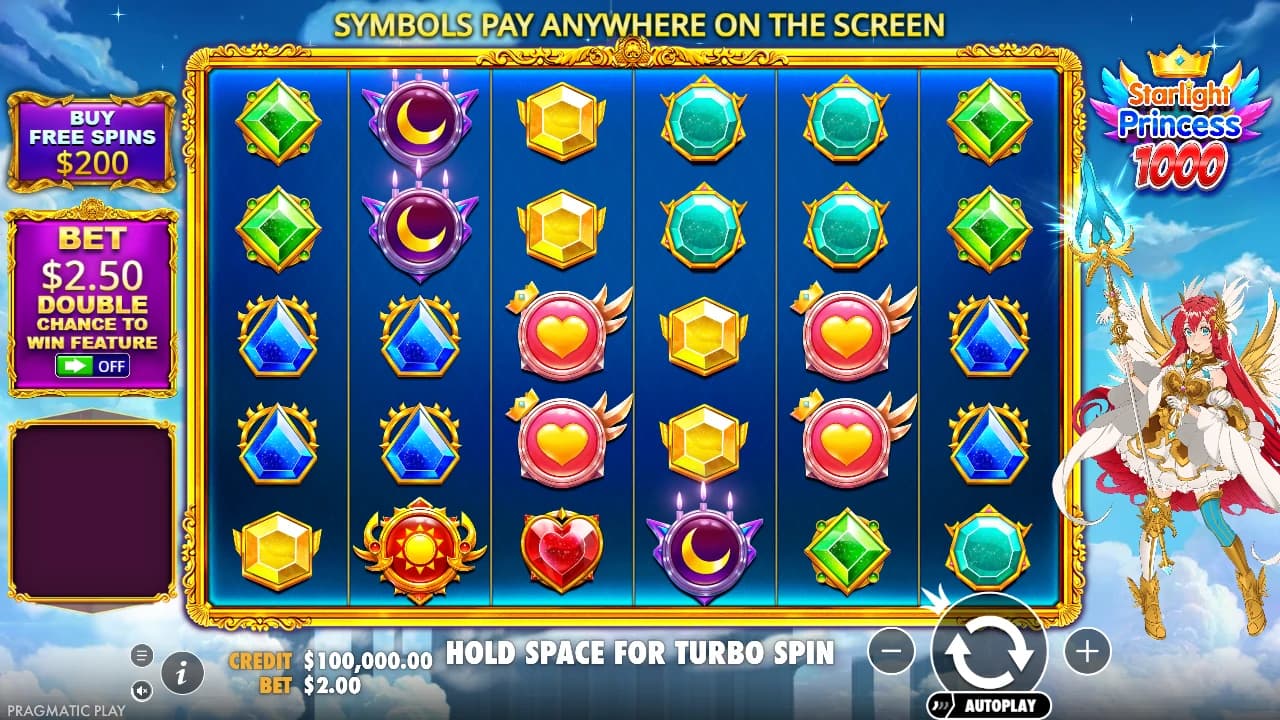
Starlight Princess 1000
Two Pragmatic multiplier systemsSugar Rush attaches multipliers to grid positions. Starlight Princess uses multiplier symbols that land during tumbles.
Explore game
Free demo & independent review
Sugar Rush 1000 remembers where symbols have won. The first explosion marks a cell; another win there starts its multiplier at 2×.
No sign-up · no deposit · full screen available
Know this game
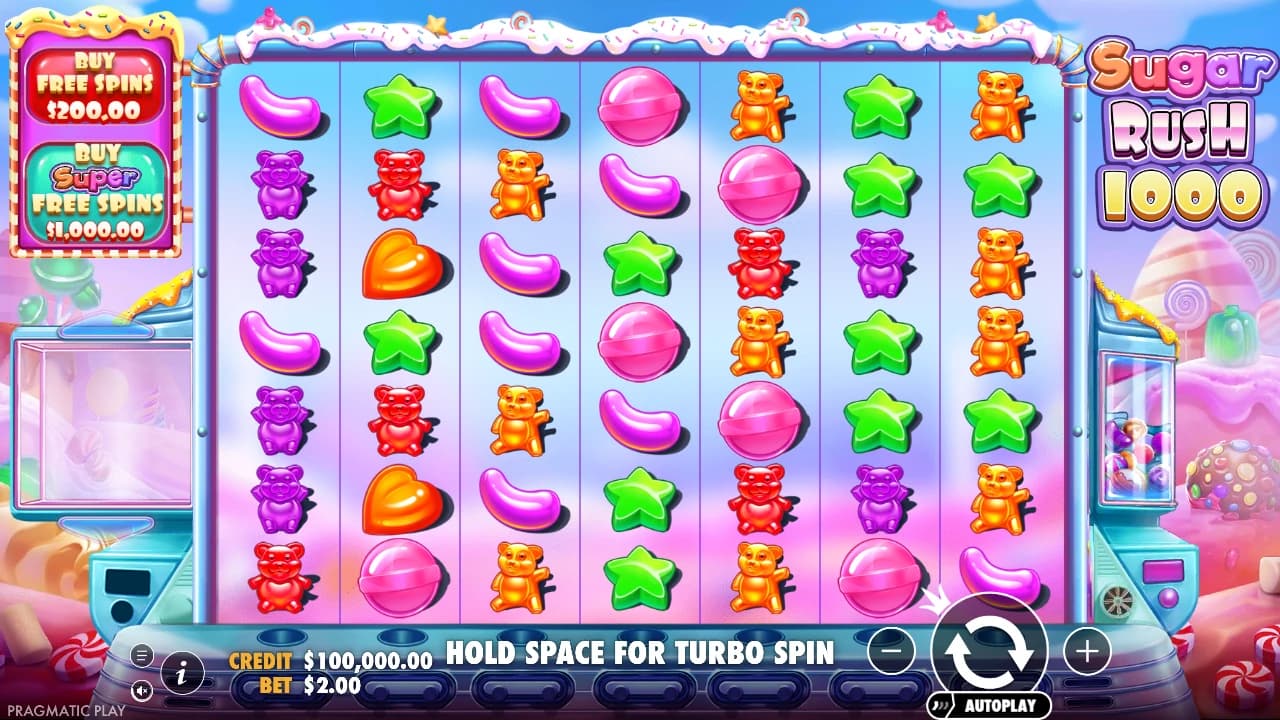
Follow the 7×7 board in two layers: the candies making a cluster and the marked positions underneath. Base-game marks last through the tumble sequence; Free Spins keeps them for the whole feature.
Inside the game
Five or more touching symbols form a cluster; diagonal contact alone does not connect them.
A cluster needs five matching symbols joined horizontally or vertically. After it pays, those symbols disappear and the grid refills.
Each winning position is marked. A later win at the same cell creates and then increases its multiplier. This is why the board’s history matters even after the original candy has vanished.
The game uses a 7×7 grid and Cluster Pays rather than fixed paylines. A winning cluster needs at least five matching symbols connected orthogonally: touching above, below, left or right. Diagonal contact alone does not join a cluster. That changes how a player reads the board. Instead of following line patterns from reel one, you are looking for groups that can expand into neighbouring cells.
After a winning cluster is paid, the symbols that formed the win disappear. The remaining symbols fall into the gaps and new symbols enter from above. If the refill creates another valid cluster, that new win is paid and the tumble process repeats. There is no need to buy another spin between those wins. A single wager can therefore generate a chain of cluster wins until the grid reaches a state with no new winning cluster.
The signature mechanic begins when a winning symbol is removed. Its grid position becomes marked. If another win later uses that same position, the position receives a multiplier. The first multiplier starts at 2× and repeated winning use can double it through progressively larger values up to 1,024×. The important distinction is that the multiplier belongs to a position on the grid, not to a symbol type. A candy symbol can disappear and another symbol can later occupy the same marked cell. What matters is whether that position participates in another win.
When a winning cluster covers multiple multiplier positions, those values are added together for that combination. For example, a cluster covering 2× and 4× cells receives a combined 6× multiplier; it does not multiply those values into 8×. This example explains the rule, not a captured outcome.
Three, four, five, six or seven Scatters award 10, 12, 15, 20 or 30 Free Spins respectively. The same counts during the feature award the corresponding number of additional spins.
Marked cells and their multipliers remain until the end of the Free Spins round. Each later win can revisit those positions and continue increasing them, up to the per-cell limit.
In the base game, the marks reset when the tumble sequence ends. This change of lifetime is the feature’s main distinction: progress can survive into a new Free Spin.
| Scatters | Spins awarded |
|---|---|
| 3 | 10 |
| 4 | 12 |
| 5 | 15 |
| 6 | 20 |
| 7 | 30 |
The saved rules offer normal Free Spins for 100× total bet and Super Free Spins for 500× total bet. Super starts every grid position with a 2× multiplier already in place.
A bought trigger can contain three to seven Scatters, so the starting spin award follows the same Scatter table. Buying the feature does not guarantee the same number of spins on every entry.
The retained $2 configuration displays $200 for normal and $1,000 for Super. The price difference pays for a different initial multiplier board, not a guaranteed return.
| Option | Price | Starting grid |
|---|---|---|
| Free Spins | 100× total bet | Standard feature progression |
| Super Free Spins | 500× total bet | 2× multiplier already on every position |
The most useful demo session is not one where the game happens to produce a large win. It is one where the player can see several different grid states.
First, watch a simple one-cluster win and note exactly which cells become marked after the winning symbols disappear. Then watch a tumble that forms a second cluster over some of those same positions. That shows the multiplier mechanic much more clearly than a headline list of possible multiplier values.
A second useful observation is how fragmented multiplier development can be. Several 2× or 4× cells scattered around the board are not automatically valuable. Their importance depends on whether later clusters actually cover them. A compact region of developed cells can be more useful than a larger number of isolated multipliers.
In Free Spins, watch how the same grid positions survive between spins. This is the clearest visual difference between normal play and the bonus. The player does not need to memorise every multiplier value; they need to understand that the board is carrying history forward.
The cell multiplier only matters when a winning cluster covers that position. The final win still depends on the underlying cluster and any other contributing multiplier cells.
They are part of the same game round. A new wager is not placed between each tumble.
Ordinary candy symbols pay according to the size of their connected cluster. The minimum is five matching symbols; diagonal contact alone does not join them.
Scatters are counted separately across the screen to trigger or extend Free Spins. Their award follows the 3–7 Scatter table rather than the ordinary candy-cluster rule.
The multiplier shown on a cell modifies a qualifying cluster covering that position. A high cell value sitting outside the winning cluster contributes nothing to that combination.
Good fit:
Less suitable:
The retained Info panel lists 96.53% normal RTP, 96.52% for Buy Free Spins and 96.44% for Super. The provider overview uses a separate 96% listing, so these exact percentages are tied to the saved game configuration.
The saved game caps both base and feature payouts at 25,000× bet. A Free Spins round that reaches the cap ends immediately and forfeits its remaining spins.
| Mode or limit | Value |
|---|---|
| Normal RTP | 96.53% |
| Buy Free Spins RTP | 96.52% |
| Super Free Spins RTP | 96.44% |
| Minimum displayed bet | $0.20 |
| Maximum displayed bet | $240.00 |
| Payout cap | 25,000× bet |
03 / The details
Catalog figures and in-game observations.
Settings may differ by version and casino.
Provider data and saved official rules describe specific game configurations. They do not certify the active RTP, controls or availability at every casino.
04 / The SlotsCollector take
Winning clusters build multiplier cells that can double all the way to 1,024×.
Sugar Rush 1000 is easy to recognise and easy to start, but the board state is more important than the candy theme suggests. If you only watch the symbols that land, you miss the part of the game that actually creates its longer-term tension: the marked positions.
The first few tumbles of a round can look ordinary. A cluster pays, the symbols vanish, and the grid refills. The interesting moment comes when a later win lands across a cell that has already been used. That is when the position starts carrying extra value. From then on, the same patch of the board becomes more important than an unmarked area with an otherwise similar cluster.
That makes Sugar Rush 1000 unusually spatial for a simple-looking slot. You are not choosing where symbols land, but you can still read the grid in terms of developed and undeveloped zones. A cluster crossing several marked positions is fundamentally different from an equally sized cluster in a fresh corner of the board.
The tumble mechanic supports that design well. Without tumbles, revisiting the same cells would be less immediate. Here, every cascade can rearrange the board while preserving the positional history underneath it. The result is that one paid spin can gradually build a valuable region before the chain stops.
Free Spins push this idea further because the marked positions persist between spins. That persistence is the real bonus feature. The free-spin counter matters, but the more important question is how much useful grid state survives into the next spin. A feature that establishes several multipliers early can feel very different from one that spends most of its spins with marks scattered across unhelpful positions.
Sugar Rush 1000 works best for players who enjoy cluster games where the board visibly evolves. It is less suited to someone who wants fixed paylines, instantly readable win paths or a bonus that resets completely on every spin.
05 / Inside the game
Tutorial, reels and game rules.
Select any image to enlarge.
06 / Find your next game
Compare the feature, not just the theme.
Sugar Rush attaches multipliers to grid positions. Starlight Princess uses multiplier symbols that land during tumbles.
Explore gameWins use Cluster Pays. At least five matching symbols must connect horizontally or vertically on the 7×7 grid.
Winning symbols are removed and new symbols tumble into the empty spaces. New clusters can then pay in the same wager.
Positions involved in winning clusters become marked. If future wins use the same positions, those cells can gain and increase multipliers, eventually reaching up to 1,024×.
No. They can remain through the tumble sequence. In Free Spins, marked multiplier positions persist between spins as well.
Three to seven Scatters award 10, 12, 15, 20 or 30 Free Spins respectively. The same counts can add the corresponding spins during the feature.
Pragmatic Play lists a maximum win of 25,000× the bet.
Pragmatic Play lists 34.48% as a provider metric for winning outcomes, rather than the rate of triggering a bonus.
The saved rules offer Free Spins for 100× total bet and Super for 500×. Super starts every grid cell with a 2× multiplier.
Sources & data verification
We check the game itself and first-party provider material, then keep the public facts tied to the version and sources we actually reviewed.
Pragmatic Play
First-party game information and configuration scope.
Pragmatic Play
First-party game information and configuration scope.
Want the full methodology? See how SlotsCollector reviews games
More to play