Pragmatic Play
Sugar Rush 1000
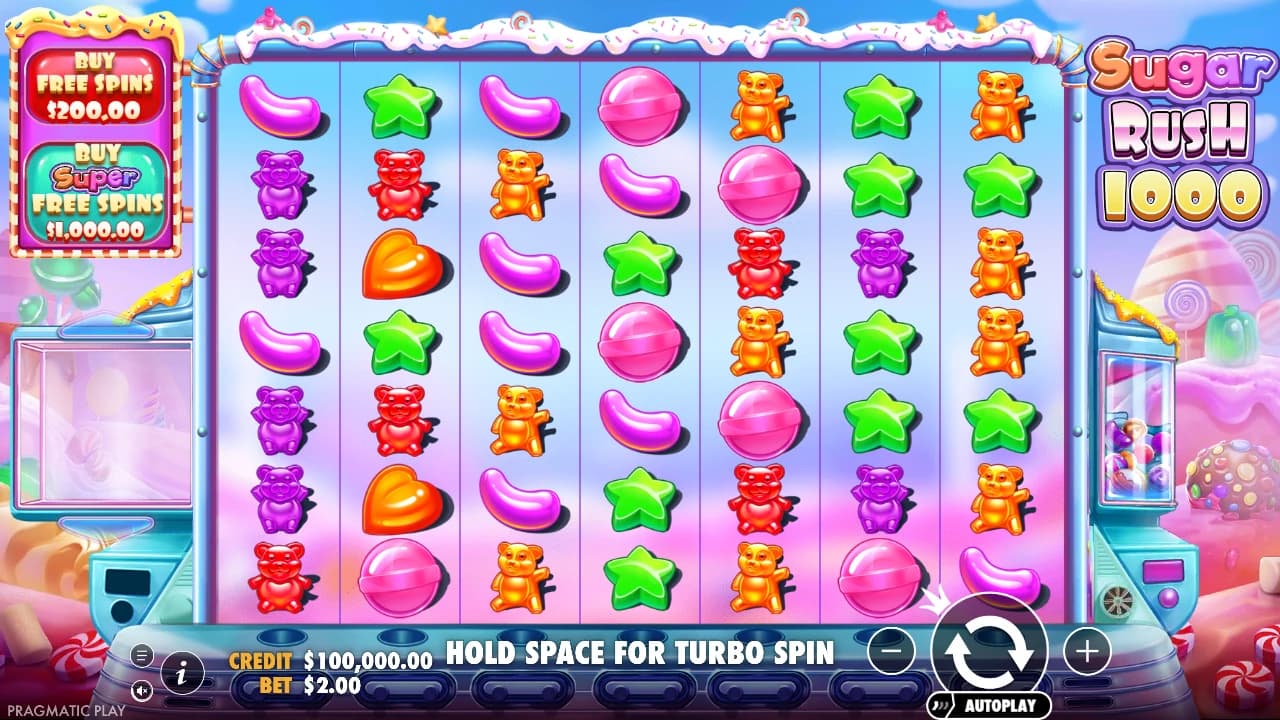
Want the board to remember winning spaces?Sugar Rush 1000 marks grid positions and doubles repeat hits to 1,024x, while Fruit Party attaches temporary values to the symbols in one cluster.
Explore game
Free demo & independent review
No sign-up · no deposit · full screen available
Fruit Party looks as bright and immediate as a candy tumble slot, but it asks you to read the grid differently. Wins come from matching fruit clusters rather than symbols counted anywhere; winning blocks disappear and can refill; and the multiplier lives on symbols within a winning group. Several modest-looking tags can therefore produce one unexpectedly large combined factor.
Know this game
Pragmatic Play's Fruit Party puts a square 7×7 symbol area at the centre of its design. This is a cluster-pays game, not a conventional left-to-right payline slot and not a pay-anywhere game in which scattered copies of a fruit always count together. The shape of a winning block is relevant. Once a block qualifies, the symbols are removed and new ones fall into place, potentially forming further blocks within the same stake.
The other distinctive idea is multiplicative symbol tags. In ordinary play, winning symbols can carry 2× values; in Free Spins, they can carry 2× or 4× values, with more opportunities to appear. Where eligible tagged symbols contribute to a paying cluster, the values multiply rather than forming a sum. Pragmatic Play describes a 256× maximum combined symbol multiplier. That is a bound on the cluster modifier, not an advertised maximum payout for a complete session.
The official player listing separately gives a 5,000× maximum win. Its saved RTP declaration is 96.47%, while the official product description gives 96.50%. Neither saved screenshot is an Info/Rules RTP panel proving which percentage a current launcher uses.
Inside the game
Fruit Party makes the winning group itself carry the modifier. First identify a valid adjacent cluster, then inspect which of its symbols have multipliers and how those values combine.
The first thing to learn is how Fruit Party recognises a paying block. Similar fruit have to form a qualifying cluster according to the game's adjacency rules. Unlike Sweet Bonanza, seeing matching fruit dispersed in distant corners does not by itself mean their counts will combine into one payout. Unlike a fixed-line game, there is no set of left-to-right paylines that every win must follow.
That makes the board a useful exercise in reading connections. Look for groups of fruit that qualify under the game's adjacency rules; a shape is meaningful only when it meets the requirements in the current paytable. The available product summary does not supply a verified minimum cluster size or the complete diagonal-connection rule, so an exact threshold should be checked in the version you play rather than inferred from the artwork.
The distinction is particularly helpful for people moving from pay-anywhere slots. Fruit Party is not difficult because of a long feature list; it is different because the geometry of one symbol group is part of understanding the result.
When a qualifying cluster wins, its symbols leave the board and replacements drop into the empty spaces. Those replacements may create another qualifying block. If so, the next win is resolved and the board continues to refill until there is no further winning cluster. The whole chain belongs to one initial spin rather than charging a fresh stake for every refill.
Do not confuse repeated animations with repeated wagers. Follow the original amount placed, the award from the first block, and any subsequent blocks formed by the tumble. A busy seven-row display can make a modest return seem spectacular, or make a cluster win difficult to follow if you watch only the centre of the board.
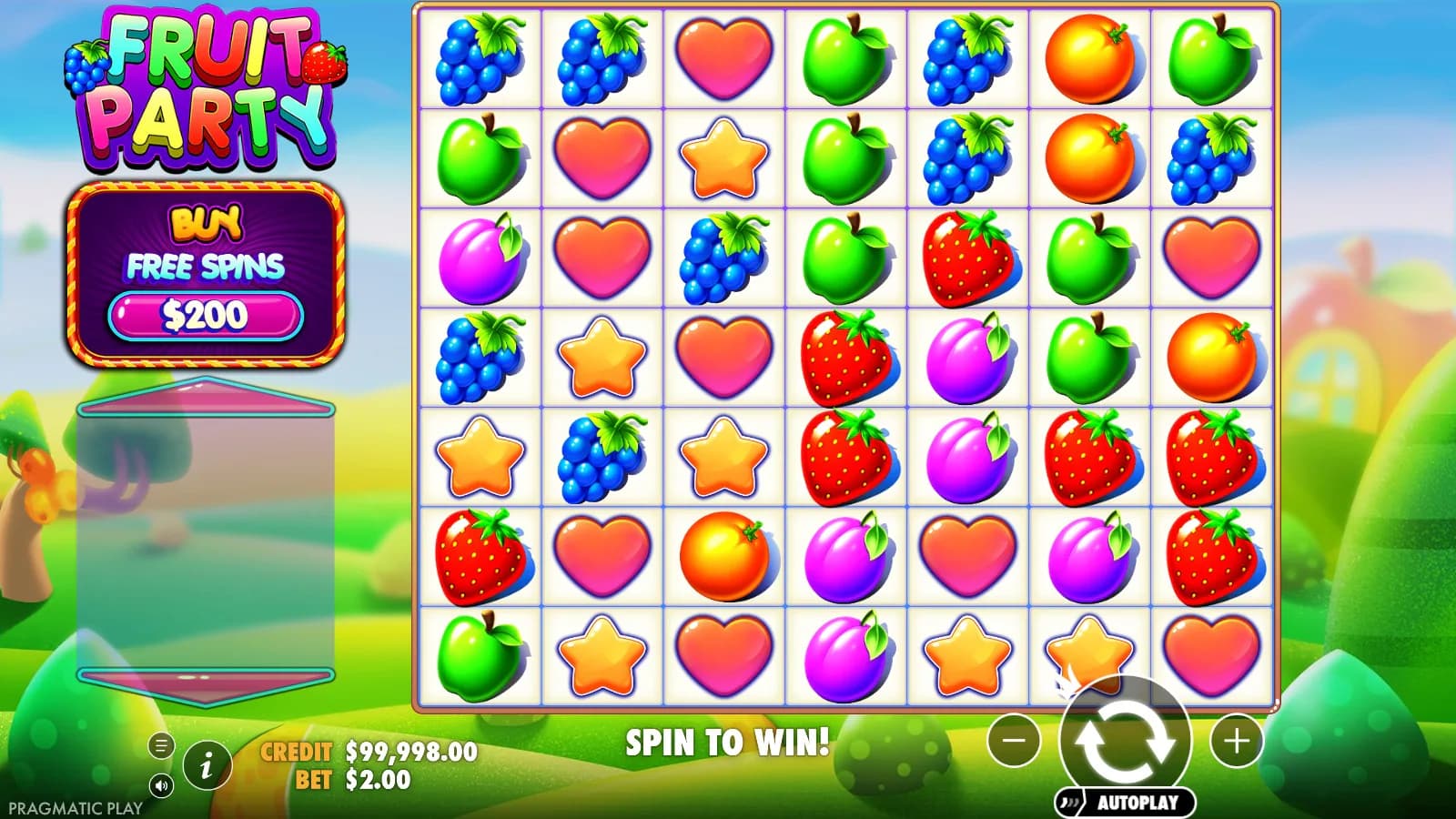
The accompanying ordinary-game frames show the board and available controls, but are not photographs of a feature payout. The multiplier tutorial is the better visual guide to the 2× and 4× tags.
Remove the winning symbols from the grid.
A new qualifying cluster can continue the same paid round.
The tumble chain finishes without charging a new stake for each refill.
The multiplier is attached to a symbol in a qualifying winning cluster. The product description states that 2× tags may appear in the base game. If two eligible 2× tags contribute to the same winning cluster, their combined factor is 4×; three such tags would combine to 8×, not 6×. In Free Spins, 4× tags can also appear, making the combinations different. Pragmatic Play states a maximum combined value of 256×.
Here is an arithmetic illustration, not a record of a demo spin: a cluster with an underlying award of 0.40 units and two eligible 2× tags has a combined 4× factor, giving an illustrated 1.60 units. A 2× and a 4× tag would combine to 8× rather than 6×. The eventual cash figure still depends on the underlying paying block; a high factor is not itself a fixed payout.
That is why the feature is more interesting than a random number flying above the screen. The cluster has to qualify first. Then the number and placement of tagged fruit inside it determine whether the modifier matters. A dramatic tag on a non-paying part of the display is not evidence that the balance must rise.
The 256× tag ceiling is also not the game's 5,000× provider maximum.
| Eligible tags in one winning cluster | Combined factor |
|---|---|
| 2× and 2× | 4× |
| 2×, 2× and 2× | 8× |
| 2× and 4× in Free Spins | 8× |
According to Pragmatic Play's official product description, three or more Scatters trigger 10 Free Spins. The underlying 7×7 cluster and tumble rules remain recognisable, but winning symbols have a higher chance of arriving with multiplier tags, and the tags can include both 2× and 4×. A larger-looking tag is only meaningful when it contributes to a qualifying winning group.
A round can therefore evolve through extra spins and successive cluster tumbles. The provider's short summary does not set out the precise last-spin, reset or 5,000× cap-stop behaviour. Treat the visible counter and current game's rules as the source for any such conditions rather than assuming that a published maximum ends a round early.
The practical way to read the feature is to distinguish three things on screen: the current free-spin counter, the size of any qualifying cluster, and the multiplier values actually attached to its winning symbols.
The retained August 2026 USD-requested game images show BET $2.00 and BUY FREE SPINS $200. In that captured configuration, the displayed purchase amount was 100 times the ordinary shown bet. This is a useful example of why a feature purchase and a normal spin are not interchangeable. It is not proof that every current operator offers Buy Free Spins, fixes the price at 100×, or accepts the same currency.
The preserved screens do not establish an ante-bet control for this title.
The saved Pragmatic Play corporate game page declares 96.50% RTP; the saved official player portal declares 96.47%. The captured screenshots contain no active runtime information panel confirming either as the particular demo's setting. Reporting “the demo has 96.50% RTP” would therefore overstate what was checked.
The 5,000× published maximum refers to the game ceiling, not the chance of reaching it. The 256× number refers to the multiplier combination on a winning cluster. Keeping these separate prevents a common misunderstanding: an impressive stack of 4× tags does not turn every cluster into a maximum-win event.
Repeated tumbles can make the board animated even when the award is small, while the largest changes depend on useful clusters receiving useful tags.
For real-money decisions, treat the game's current information panel and applicable operator rules as authoritative for the version available to you. An August capture does not certify today's stake limits, win probabilities or feature price.
First, learn to recognise a qualifying connected fruit group. Compare it with a board containing many matching symbols separated into smaller pockets. This reveals the practical difference between cluster pays and pay-anywhere much faster than memorising a marketing slogan.
Second, watch a complete tumble sequence. Note when the first group vanishes and whether the refill creates a fresh paying block. Try to match the final win display to what was actually removed. Multiple visual changes can be the result of one paid action.
Third, look for multiplier tags inside the paying cluster. When more than one contributes, test the arithmetic mentally: two 2× tags make 4×, not a 4× additive bonus because the multiplication happens between the tags. Save the Free Spins comparison for when the relevant mode is actually available; a retained tutorial picture is not a recorded live bonus.
Finally, compare the displayed ordinary bet with any feature-purchase option. The historical $2 and $200 example shows how different those decisions can be. It is not a recommendation to purchase a feature or evidence that doing so improves expected value.
Players who enjoy seeing the position of symbols matter, want to follow clusters that disappear and refill, and like multipliers whose arithmetic is tied to the symbols that actually won. Fruit Party is also a useful comparison point for newer grid-progression slots: it delivers plenty of movement without requiring a persistent map of upgraded spaces.
A player looking for predictable progress or a bonus menu with selectable modes may prefer another structure.
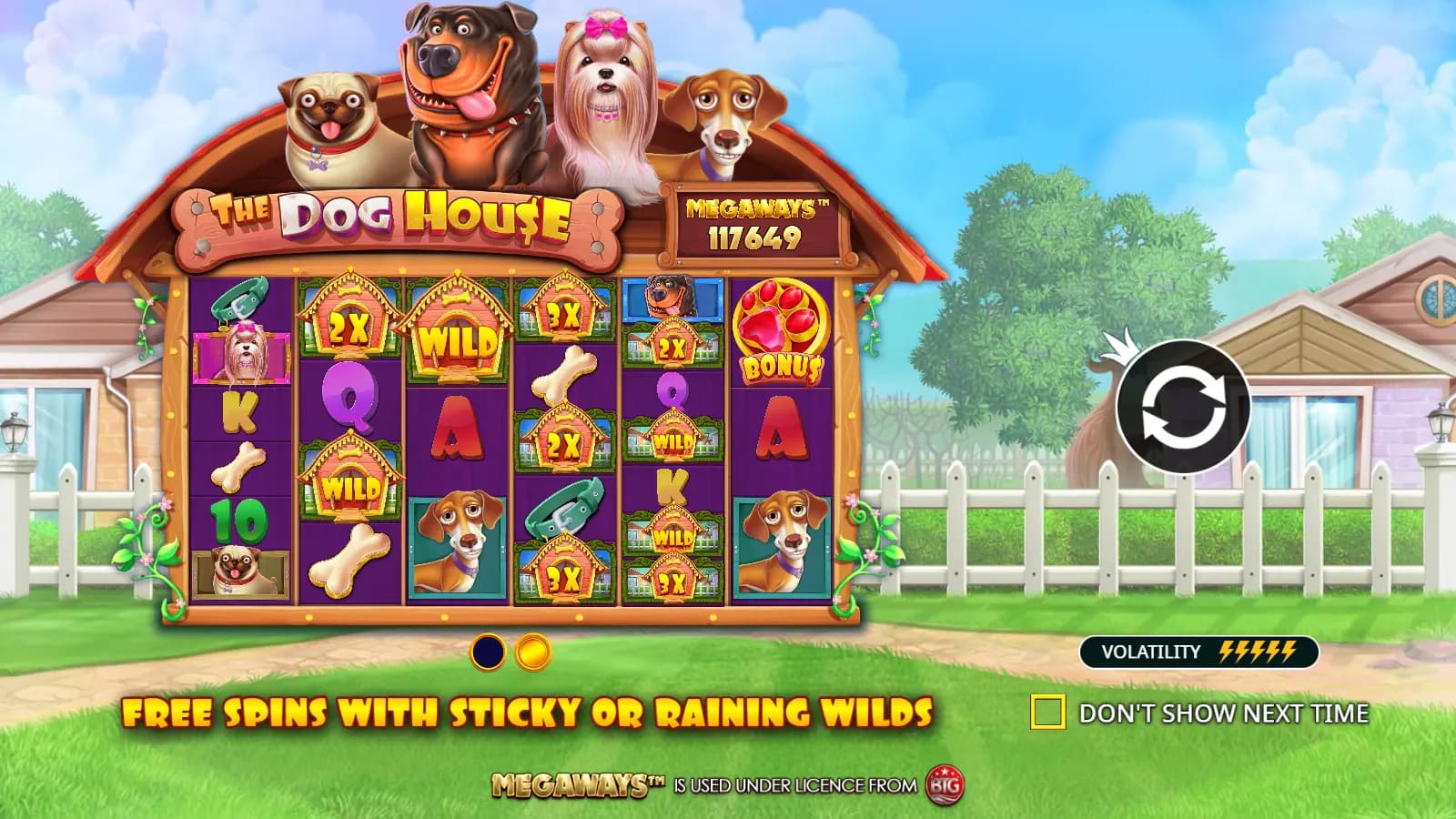
Compared with Sugar Rush 1000, where marked positions can develop across hits, Fruit Party keeps its attention on the multiplier carried by current winning symbols. Compared with The Dog House Megaways, Fruit Party has no choice between Sticky and Raining Wilds; it is a focused cluster game.
03 / The details
Catalog figures and in-game observations.
Settings may differ by version and casino.
The screenshot shows one selected $2 bet, not a minimum or maximum, and must not be treated as a complete stake range. Likewise, a single still image cannot establish a buy confirmation process, probability of entering a feature or its long-term RTP.
04 / The SlotsCollector take
Fruit Party succeeds because the modifier is visible inside the win it changes.
A player can understand a modest 2× tag immediately, then see why several tags combining multiplicatively are more interesting than one large number floating beside the reels. The 7×7 grid asks you to care about connections; tumbles give that same board another chance to form paying blocks without another stake.
That clarity has a cost. Some screens look exuberant but contain weak or disconnected groups, and multiplier animations may be more memorable than the actual balance change. The game is not built around durable progress that improves with each paid spin. Its strength is the tension between cluster formation and temporary tags. If you like that small piece of maths, Fruit Party remains distinctive. If you prefer persistent states or fewer symbols to scan, a calmer line-based slot may be a better fit.
05 / Inside the game
Game captures and reviewed supporting images.
Select any image to enlarge.
06 / Find your next game
Compare the feature, not just the theme.
Sugar Rush 1000 marks grid positions and doubles repeat hits to 1,024x, while Fruit Party attaches temporary values to the symbols in one cluster.
Explore gameThe Dog House Megaways replaces square clusters with up to 117,649 ways and lets players choose Sticky Wilds or Raining Wilds Free Spins.
Explore gamePragmatic Play lists an official free-game option. Free-play credits are not a real-money prize.
No. The 7×7 board uses cluster pays. Qualifying connected groups matter; scattered copies of one fruit are not automatically one win as they can be in some pay-anywhere games. Exact minimum/adjacency clauses should be confirmed against the version's paytable.
They multiply each other when eligible tags participate in a qualifying cluster. Two 2× values combine to 4×. The provider lists a maximum combined cluster multiplier of 256×.
Three or more Scatters trigger 10 Free Spins. According to the product description, 2× and 4× tags have an increased chance to occur on winning symbols. Additional Scatters can award more spins, with 10–14 extra mentioned for a three-to-seven-Scatter retrigger range.
No universal price is established. The retained August 2026 image in a USD-requested context shows BET $2.00 and BUY FREE SPINS $200, a 100× ratio for that captured screen only.
The saved corporate product page lists 96.50%; the saved player portal lists 96.47%. Neither was verified as the RTP of the active embedded demo by the supplied screenshots.
The official player portal lists 5,000× the stake. This is distinct from the 256× ceiling on combined multiplier tags within a paying cluster, and neither figure predicts a result in a short demo session.
Sources & data verification
We reviewed first-party game documents and provider material. The facts below retain their source and configuration; this review does not certify a current playable demo.
Pragmatic Play
Primary provider evidence for the game rules, published configuration, feature behaviour and release information used by the editorial review.
Pragmatic Play
Official provider listing; declared game configuration, release and maximum payout.
Want the full methodology? See how SlotsCollector reviews games
More to play