04 / The SlotsCollector take
A moving ship is a cue, not a jackpot countdown
Sails of Riches puts a moving pirate ship beside a six-reel game, but the ship's apparent approach does not increase jackpot odds. The free demo is useful for learning when Gold Coins feed that display, when six Coins start Cannon Defense Lock, and how the separate Free Spins Wheel changes its possible spin counts.
Sails of Riches invites you to watch the ship as much as the reels. Gold Coins fly towards it and its artwork moves through five stages, an easy visual story to read as a jackpot getting closer. The current Play’n GO description and the first photographed INFO panel say the opposite about the actual trigger: the number of collected Coins and the ship's apparent distance do not change the chance of a Ship of Riches award. Once at least one Coin has been collected, that event can happen randomly. Treat the animation as a way to recognise the feature, not a meter to chase. This is the crucial distinction for deciding whether another demo spin teaches you anything new.
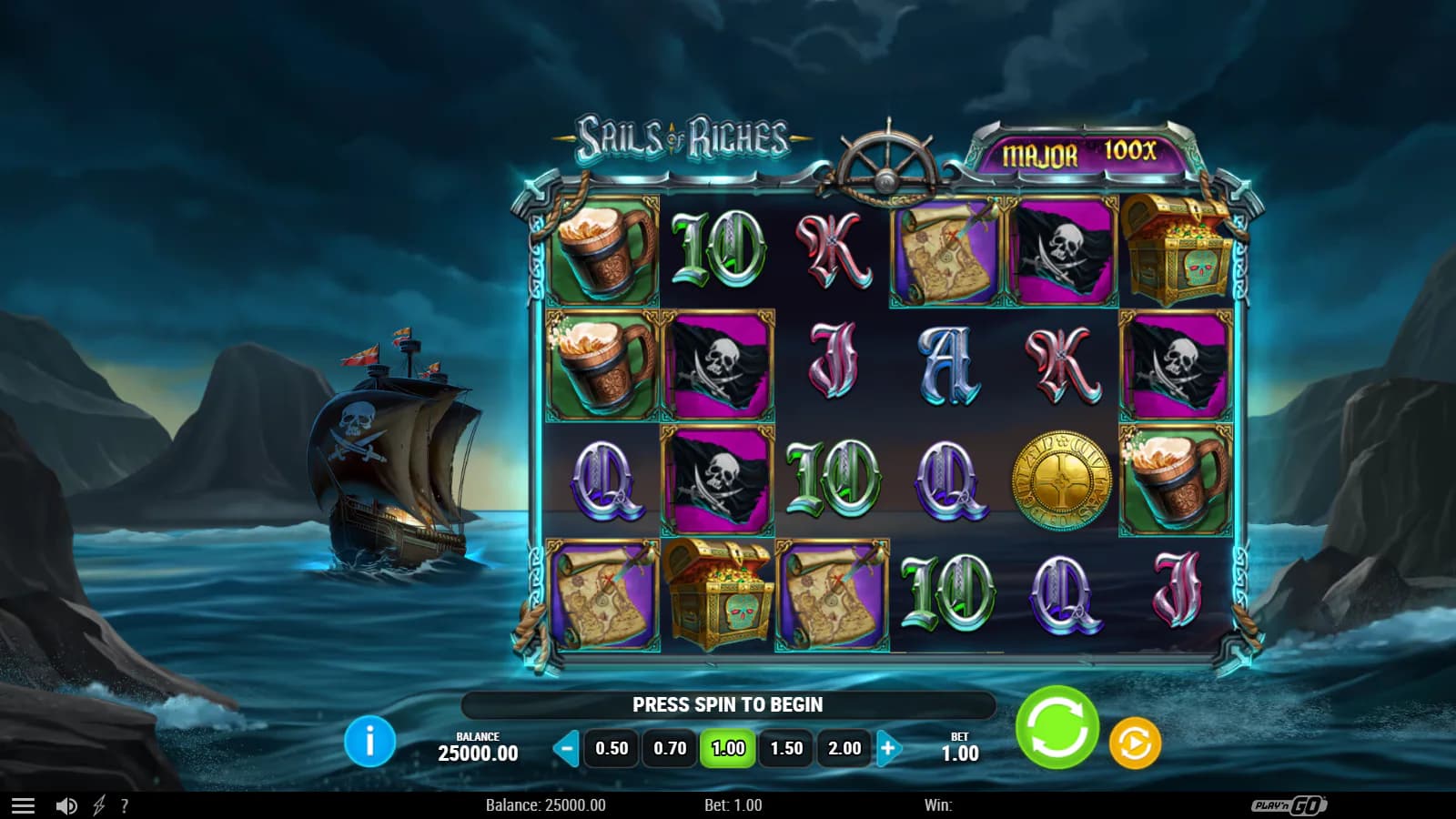
The ordinary game pays adjacent matching symbols from the leftmost reel across a six-reel grid. The inspected opening screen shows four visible rows, a Gold Coin on the board, a MAJOR 100× label above the reels and a selected 1.00 virtual bet. Its balance reads 25,000.00 and PRESS SPIN TO BEGIN is still present, so this is a starting board, not evidence of a jackpot. Two later captured boards change the portraits, flags, maps and card ranks; one includes a ship Wild and a MINI 20× label. Their displayed balances are 24,999.00 and 24,998.00 at the same bet, with no win shown. They establish distinct ordinary states, not the frequency or value of a feature.
Play’n GO calls the ship award a Pirate Progressive Style feature in its public description, while the captured INFO panel names the visible panel SHIP OF RICHES. In that INFO view the four displayed prizes are MINI 20×, MINOR 50×, MAJOR 100× and GRAND 1,000× total bet. These labels explain the header's changing jackpot name; a MAJOR or MINI banner sitting above an ordinary screen is not itself a recorded prize. The feature is random when eligible, and the decorative ship growth is deliberately disconnected from trigger likelihood. That makes this a poor game for any strategy based on judging how near the ship looks.
Cannon Defense Lock gives the Gold Coins a different, more concrete job. Six Coins on the reels trigger it. The provider also describes a four-Coin board that receives a re-spin for a chance at the last two; a lone Coin instead feeds the ship display. Once Lock begins, ordinary symbols leave, six Coins stay fixed and the counter starts at three Re-Spins. Each new Coin refreshes that counter to three. Available Coin multipliers are x1, x2, x3, x5 and x10; when no new Coin lands, revealed values are added. A completely filled screen guarantees a 500× total under the provider's rules. These are Lock-round mechanics, not outcomes observed in our three base-game photographs.
Free Spins takes a third route rather than simply adding more Coins to the ship. Its trigger brings up a large wheel: the outer ring carries possible spin counts and the inner ring carries multipliers from x1 to x5. More triggering Scatters remove some low-spin-count segments, shifting the available options towards larger allocations. The published description does not give a single guaranteed starting spin count here, so the sensible demo question is what the actual wheel displays when a trigger occurs. Do not confuse the number of Scatters feeding this wheel with the Coin tally decorating the ship or the six-Coin threshold for Lock.
The three features offer different kinds of information to watch. The ship shows a possible random tier prize, but visual proximity does not price it. Cannon Defense Lock has a visible entry condition and a resetting Re-Spin counter; its final result depends on the revealed and added multipliers. The Free Spins Wheel changes its available spin-count segments when more Scatters trigger it. One layout can therefore display a jackpot tier, a Coin and normal symbols without proving that any feature has paid. Reading the labels and actual win field separately is more useful than treating every animation as cumulative value.
The audited Play’n GO card lists 96.2% RTP, high volatility, a 0.10–100.00 bet range and a 10,000× maximum. The 1.00 practice bet visible in our images is one selected demo setting, not the range used to derive those provider figures. High volatility describes a risk profile, and 10,000× is an upper limit; neither tells you how many spins it takes to see a ship award, Lock or the wheel. We did not photograph any of those bonus outcomes, so the explanations of their rules come from the current first-party description and the visible first INFO page, not a claimed sample of feature payouts.
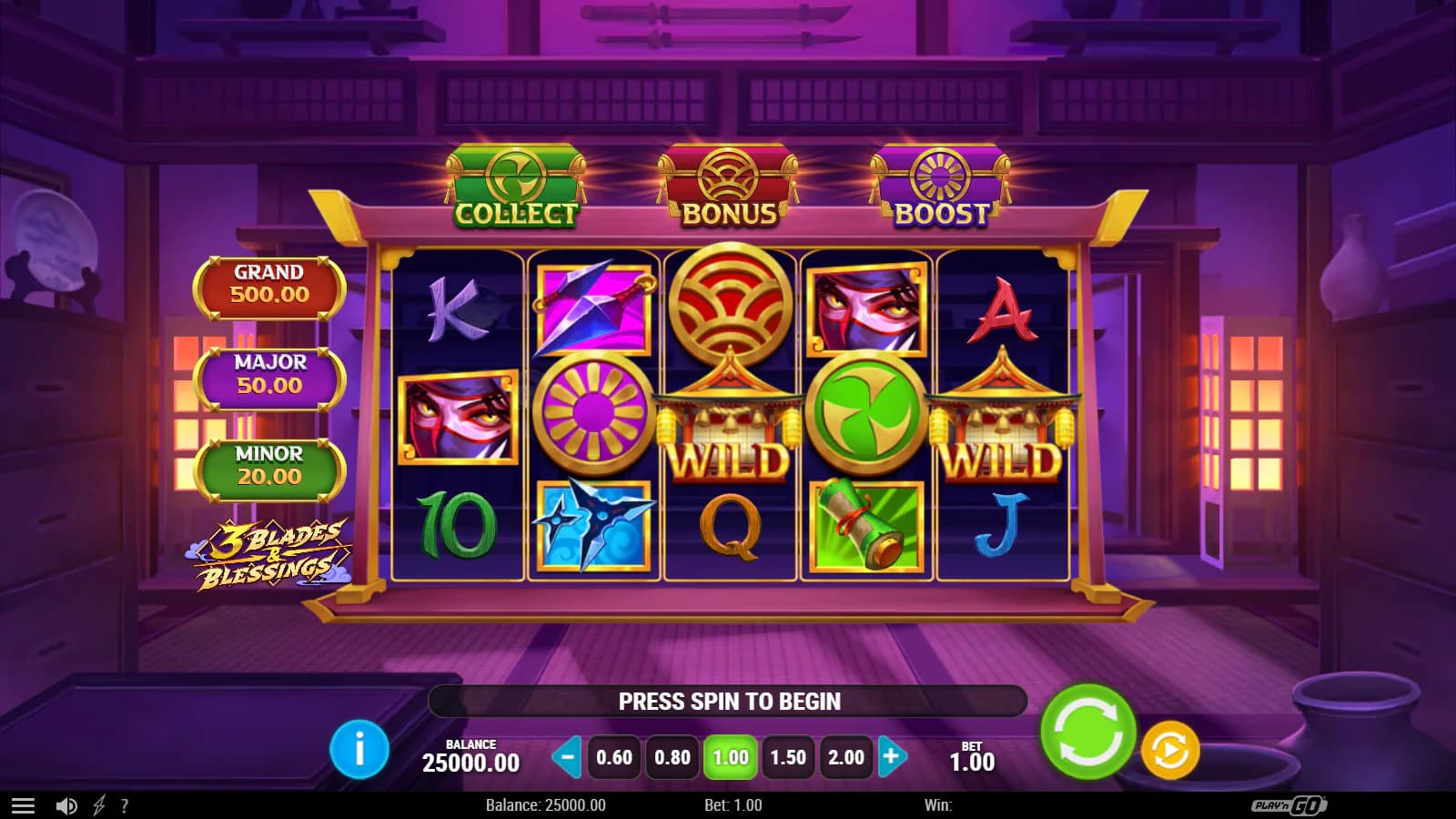
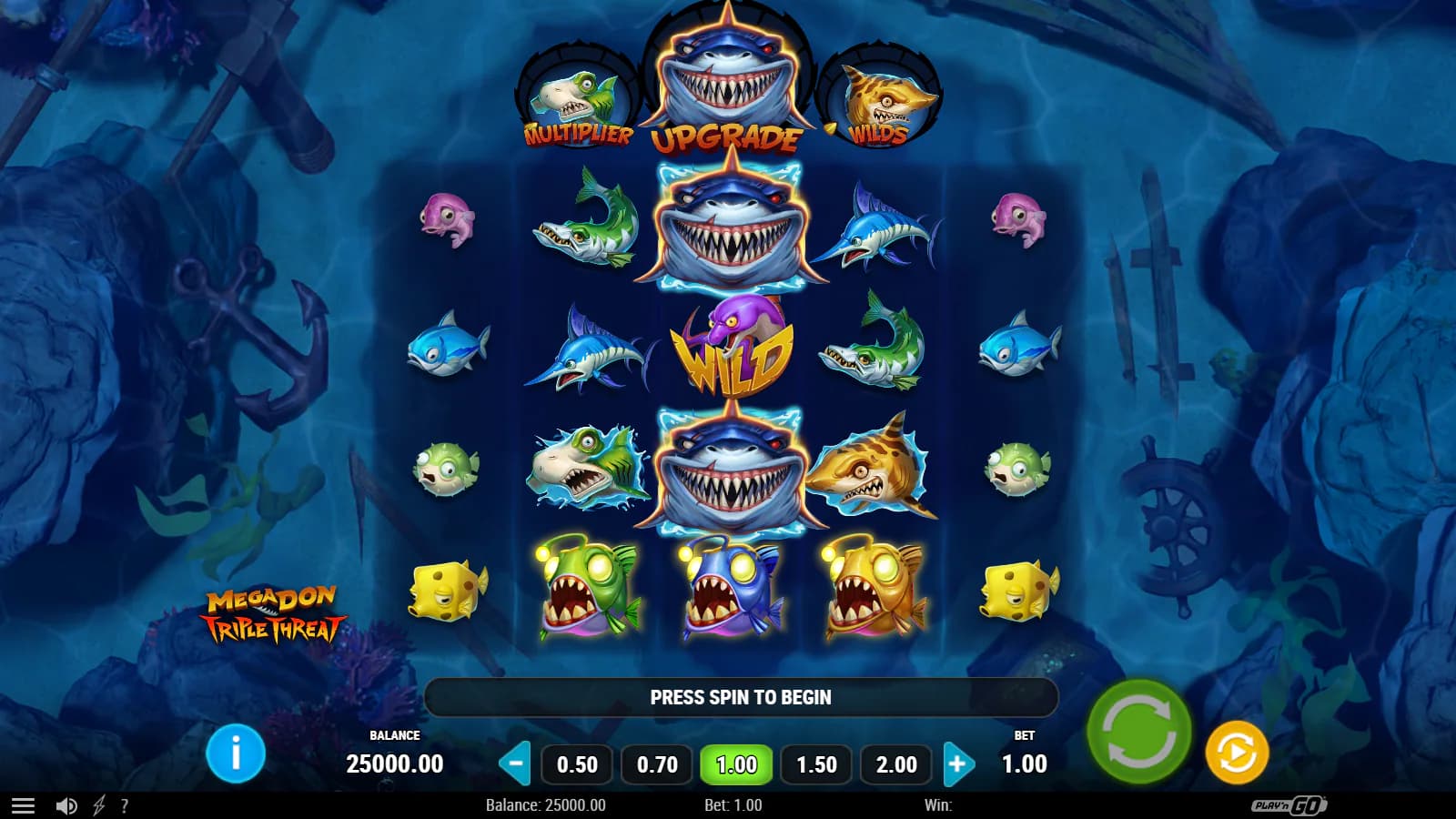
Sails of Riches suits players who enjoy keeping three reward systems straight and who want a pirate theme with more to inspect than a single Free Spins trigger. It is less comfortable for anyone who sees the approaching ship as stored progress or expects a banner such as MAJOR 100× to be a credited win. Compared with 3 Blades & Blessings, where colour-coded chests point to different bonus combinations, this game makes Coins, a random ship award and a separate wheel do distinct work. Compared with Megadon Triple Threat, the visual-tracking warning is familiar, but Cannon Defense Lock gives you a separate six-Coin entry rule to recognise. The free demo is most valuable as a rules-reading exercise before any decision to play elsewhere.