04 / The SlotsCollector take
One Scatter changes the board; three change the round
A single Scatter can make a reel taller in Static Nightmare Abyssways; three Scatters are needed to enter its eight-spin ABYSSWAYS feature. The official demo makes the changing screen easy to inspect, while the separate Wild rules explain why the bonus is more than a larger grid.
The useful question in Static Nightmare Abyssways is not simply whether a Scatter has appeared. It is what that Scatter changed. Play’n GO says a landed Scatter expands its reel by adding symbol positions, up to a six-row maximum. The second inspected demo frame shows one Scatter on the second reel with taller outlined positions above the ordinary board. That is a visible example of a changed grid, not a photograph of Free Spins starting: the provider requires three Scatters for that entry. Keeping the two thresholds apart makes the game much easier to read. One symbol can change the layout in the base game, while a qualifying group opens a different sequence with its own Wild behaviour.
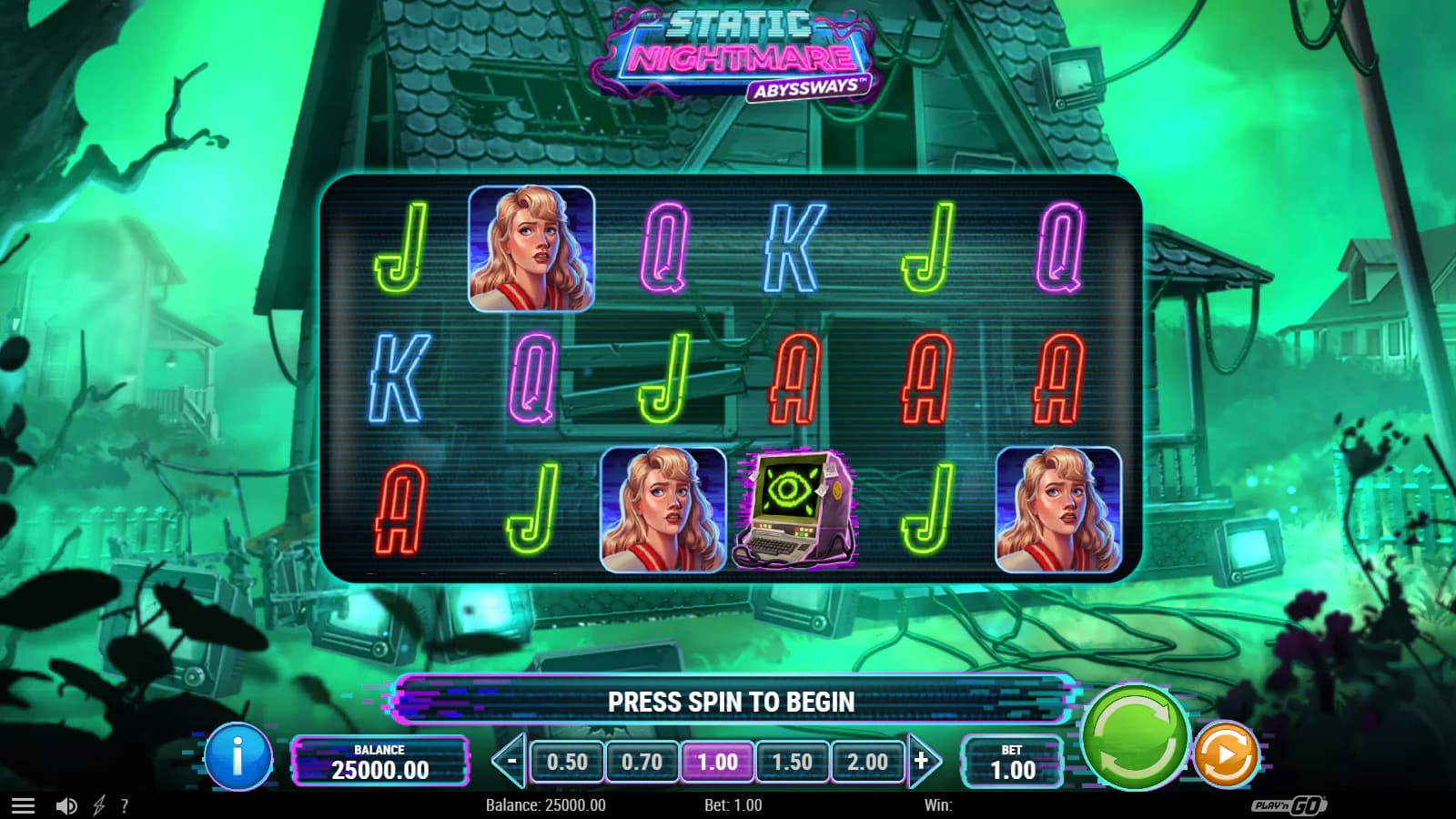
At the untouched opening, the official practice game presents six neon columns in a television-glitch horror setting. A frightened blonde portrait, card ranks and an arcade-cabinet symbol sit on a compact three-row display. PRESS SPIN TO BEGIN appears above a 25,000.00 virtual balance and a selected 1.00 bet, and the WIN field is blank. This is a starting state, not evidence of how frequently a feature or payout occurs. A later settled frame has the visible Scatter and expanded positions at balance 24,999.00. Another ordinary frame returns to a compact board with cassette and arcade symbols at balance 24,998.00. Both later screens also have empty WIN fields. The sequence demonstrates changing reel height without claiming that any photographed spin won.
The base-game Wild rule adds a second variable to watch. According to the official description, whenever a Scatter appears, Wilds already on the reels can expand by one position. Each Wild also has its own chance to grow at the end of a spin. A Wild substitutes for ordinary symbols but not for a Scatter. That last exception matters: a growing Wild cannot be counted as an extra Scatter toward the three needed for Free Spins. The photographed Scatter scene does not show a settled Wild expansion or a win, so the frame should be used to recognise the reel outline rather than to infer the probability or value of a Wild event.
Three Scatters launch eight ABYSSWAYS Free Spins. The provider's description makes clear that this is not simply eight repeats of the base layout. At the end of each feature spin, marked symbols at the bottom fall away and a new full row appears at the top. Reel height therefore changes between spins. Further Scatters can add Free Spins within a cap, but the current public description does not give a specific maximum count. The reviewed image set contains no Free Spins screen, so neither an exact bonus-board arrangement nor a retrigger frequency can be established from the screenshots. The sensible demo test is to compare the height before and after each feature spin if you reach it yourself.
Wilds also change their role during the feature. In the base game they can grow; in Free Spins they become sticky. The provider describes their movement as a sequence: they may expand downward when prompted, then compress and try to slide sideways into available positions between spins. A sticky Wild therefore need not occupy an identical footprint on every bonus screen. It can remain part of the feature while the shape of the board and the places where it can help a match change. No Wild is presented as a guaranteed paying combination, and no multiplier is specified in this published rule. Watch where a Wild can substitute after the board shifts, not just whether it stayed visible from the preceding spin.
The first captured INFO page is a Symbols paytable rather than the complete rulebook. It displays several character and item payouts and the headline 'Win up to 30000x your normal bet!', consistent with the official 30,000× maximum. The photographed INFO footer shows a 0.70 bet, whereas the three gameplay screens show 1.00. These are different selected stake displays, not a change in the game's RTP and not a recorded 30,000× result. The image does not document the whole ABYSSWAYS sequence, sticky-Wild movement or the full set of possible paytable configurations. The provider text supplies those feature rules; the images supply the exact visible screen states.
The reviewed Play’n GO listing gives 96.2% RTP, Medium volatility, a 0.10–100.00 bet range and a 30,000× maximum win. RTP is a long-run model figure, not a return promised across a short demo session. Likewise, the maximum is a ceiling rather than a representative payout. The demo's first two practice spins, shown here only as screen states, are much too small a sample to say anything about hit rate or bonus frequency. The selected 1.00 stake is useful for orienting yourself in the captured interface, but stakes and RTP options should be checked in the version you actually open.
Static Nightmare Abyssways suits someone who enjoys tracking how a board changes, not only reading a final total. Its clearest design idea is a two-stage escalation: a Scatter can expand one reel now, while three Scatters move play into a feature where rows and Wilds reconfigure over successive spins. The neon arcade and haunted-house imagery give that movement a distinct setting without explaining the mathematics on their own. Try the free demo to locate the Scatter, expanded outlines and the WIN field, then read the official feature description before judging an unphotographed bonus. If you prefer a stable grid or a bonus whose state is obvious from one still frame, this is a less straightforward choice.